Monday, March 28, 2011

Opening of the Kenya Forest Service Gate


The New KFS Gate


The Director of the Kenya Forest Service Mr. David Mbugua recently presided over the opening of newly constructed gate at the KFS headquarters in a colourful yet brief ceremony. The gate constructed to the tune of Ksh. 2.1 million is an attractive addition to development works going on at the headquarters which are meant to soon transform the face of KFS.
The Director commented that the gate was a landmark that will improve the corporate image of the Service as well and make Karura secure for visitors.

The KFS Director Mr. David Mbugua cuts the tape to officially open the new gate

Karura Forest is home to some unique features, like some of the most indigenous uplands forest tree species, the Mau Mau caves, a waterfall, various species of wildlife and a beautiful lake called Lake Lilly. The Service together with the Friends of Karura CFA and financial support from other partners including the East African Breweries found it prudent to secure the forest and protect these invaluable features.
The forest was recently re-launched as tourism site and is being marketed by the Kenya Tourism Board as one of the attractive sites in Nairobi. The capital city is now home to a national park and an indigenous forest both within 10 minutes drive from the city center albeit in the opposite directions.
Story by Emmah Nerima

Thursday, March 24, 2011

KFS to Develop Arabuko Sokoke Forest

The Arabuko Sokoke Forest
The boardwalk at Mida Creek

A Nature Trail in Arabuko Sokoke forest

A vehicle track in the Forest

An animal watering hole

One of the community bandas situated adjacent to the forest


Arabuko Sokoke Forest, a 42 000 hectare gazetted state forest straddling Kilifi and Malindi Forest Zones is unique in many ways and is now destined for a major promotional campaign by KFS in order to attract more visitors and put it on the world map as one of the remaining coastal dry forests in the region.  The forest is home to several endangered wildlife species found nowhere else in the world. It is also the biggest such forest in the eastern coastline of Africa and hosts such other game as forest elephants, sykes monkeys among other mammals, reptiles and amphibians.
During a recent trip to determine the potential of the forest and to develop a communication plan to promote the forests, officers led by the Chief Ecotourism Officer Mr. Philip Ireri sampled the attraction of the forests and talked to various stakeholders who benefit from the forest and would like to see its sustainable development.
To the surrounding community, the forest is a source of income for thousands as community groups have formed Community Forest Associations (CFA) which are carrying out various sustainable income generating activities in the forests. Some groups have placed traps to capture the unique butterflies in the forest which they export. Others are involved in bee keeping and have been allowed to place their bee hives in the forest and as a result they have been harvesting high quality honey with a distinctive taste thanks again to the unique flowers and vegetation abundant in Arabuko Sokoke.
There are also community bandas and other eco-tourism facilities which host tourists visiting the forest. The forest encompasses Mida Creek which is occupied by various species of the mangrove and also the site of a 250 meters community owned boardwalk that meanders through think mangrove foliage.
Some community members with indigenous knowledge of the forest and tour guiding skills have also formed a tour guides association with offers guiding services to tourists in the forest. On such member is Mr. Johnson Kafulo who says that the potential of the forest has not been fully harnessed as it offers attractions that cannot be found elsewhere in the world adding that the forest has been identified as an Important Bird Area (IBA).
According to the Malindi Forest Zone Manager Mr. Bernard Orinda, the forest is a bird watchers paradise with over 235 bird species having been sighted in the forest. Among the endangered and endemic bird species found in the forest include the Spotted Ground Thrush, the Clarkes Weaver Bird and the East Coast Akalat. Others are the Amani Sunbird, the Sokoke Scopes Owl and the Sokoke Pipit.
The forest is also hope to other endemic animals like the Arders Dwika, Sokoke Bushtail Mangoose and the Golden Ramped Elephant Shrew as a well as endemic species including the Ornate Tree Frog and the Batany Dwarf Toad.
The according to Mr. Ireri, KFS in partnership with various development partners is set to improve facilities including infrastructure in the forest. This he said will add value to the forest and place it at a vantage position in as far as tourism is concerned thus generating much needed income for conservation and the neighbouring community.
Story by Leakey Sonkoyo, Corporate Communications Officer, KFS

Tuesday, March 22, 2011

K.F.S. And W.W.F. To Conserve And Rehabilitate Transmara Forest ReserveE


The Kenya Forest Service (KFS) and the World Wide Fund for Nature, Kenya Country Office (WWF - KCO) have signed a memorandum of understanding (MOU) that will see the two organisations take steps to conserve Transmara Forest Reserve in the Mau Forest Complex for the next five years. 

According to the MOU, the two organisations will work together towards rehabilitating degraded areas as well sustainably managing the over 35 000 ha forest for the benefit of both the local community and the country as a whole. The forest covers stations; Nairotia, Nyangores and Olenguruone forest blocks and is the catchment of both the Mara and Sondu Miriu Rivers. The forest adjacent communities will be empowered through participatory forest management initiatives as well as establishment of livelihood improvement schemes.

WWF will support the development of participatory forest management plans for each of the forest blocks in partnership with the local Community Forest Associations (CFA) and also the implementation of the same.

Story by Leakey Sonkoyo, Corporate Communications Officer, KFS

KFS Director Visits Community Development Projects In The Mau And Malagat Forests


The KFS Director Mr. David K. Mbugua recently visited community projects in the Mau Conservancy financed by the Green Zones Development Support Project (GZDSP). GZDSP is an African Development Bank (AfDB) funded project that seeks to rehabilitate natural forests, restore hilltops and watersheds and promote participatory forest management.

Another important component of the project is to support forest adjacent communities through promotion of livelihood improvement programmes. The Director accompanied by the project officers including the Project Manager Mr. Jerome Mwanzia visited such programmes in the Sururu and Malagat areas of the Mau Conservancy. 
The KFS Director Mr. David Mbugua (r) is shown the map of the rehabilitated Sururu Forest by the GZDSP Manager Mr. Jerome Mwanzia. The Nakuru Zonal Forest Manager Mr. Mukundi looks on

In the Mau Forest Complex, the Director went to a forest rehabilitation site at Sururu Forest Station where GZDSP had supported its rehabilitation. He then met the station’s Community Forest Association (CFA) members who expressed their appreciation for the support they had received in establishing income generating activities which includes a fish farm. The project was financed by GZDSP in order to empower the community financially thereby reducing pressure on the neighbouring forest.

The Director then later on launched development projects initiated by the Community Food and Environmental Group (COFEG) with support from the project.

His visit did not end there as on the following day, he presided over the opening of the Malagat Bridge which is situated in the Malagat Forest. The GZDSP financed the building of the bridge to the tune of Ksh 7.8 million after the old one become unusable. Communication between the Hill T trading center and Mugumoine which lies beyond the forest had been severely affected following deterioration of the bridge and thus its opening was welcomed with relief by the surrounding community.
The KFS Director Mr. David Mbugua cuts the tape to officially open the new Malagat Forest Bridge. The bridge was constructed by the GZDSP to the tune of Ksh 7.8 million
Addressing the community later at a public baraza, the Director thanked them for protecting the forest which he said was really theirs. He promised to give first priority to the youth who had been acting as scouts and assisting in forest patrols when KFS roles out ranger recruitment.

Story by Leakey Sonkoyo, Corporate Communications Officer, KFS

Blog Transition


In a journey that  started with an innocuous single post on 2nd February, 2010 and after exactly one year and a handful of days we have seen 290 posts shared on this blog. 

On that first post of Kenya Forests Blog aptly titled "Off the blocks", the Administrator Mr. Raphael Mworia promised that the space he was creating would be a refreshing one in which stories and pictures on Kenyan forestry would be shared. He promised facts and figures, a peek into forestry reforms and a discourse on the sector. He further promised to share news and views on forestry resources, the estate, management,challenges and opportunities. In my humble view I believe he has shared with his readers all that he promised and more. 

After one year and over 16,500 visitors, Mr. Mworia has had to leave the organisation and I am privileged to have been entrusted with the humbling task of ensuring that the blog does not die and it retains it vibrancy and relevance. I must confess that I will need all the support I can get from you the blog readers, my colleagues and members of the Communications Team to continue this journey.

I promise to keep you posted on what is happening in the forestry sector nationally, globally and also internally in Kenya Forest Service. For a well balanced outcome, it will be necessary that all members of staff support this initiative by being contributors. Let me know what you are achieving in your various work stations. Those involved in cutting edge forestry innovations, let us share with the world what you are doing. It does not matter that you imagine your work is routine and therefore not worth to be known by others, but you will be surprised to know that what sounds routine or "kawaida" to you as Kenyans like saying could be breakthrough to another person or part of Kenya and the world. 

I look forward to sharing with you your work even as we wish the founder of this blog all the best wherever he goes. 

Happy reading

Leakey Sonkoyo
Adminsitrator/Editor
Kenya Forests Blog
Tel- 0723-430348

           sonkoyoleakey@yahoo.co.uk


Tuesday, March 1, 2011

Board Tours Field Stations & Partner Facilities


 As part of its induction and familiarisation the members of KFS Board of Directors were in the field for four days traversing the Mau, North Rift, Western and Nyanza Conservancies  in a visit aimed at allowing them an opportunity to interact with field officers and some of the stakeholders who partner with the Service.

While in Mau, they visited the Menengai Forest Station that is host to Geothermal Development Company’s (GDC) steam drilling units. GDC is a licensee exploring for geothermal for power generation from the various steam outlets found in the forest.
Another facility visited was the Kibunja China Road and Bridge Corporation former site and residential camp for the contractor of the Lanet-Timboroa Highway project.  As part of the licensing arrangement, KFS has inherited the two sites which will be converted into Staff residential compound and Field Base.

The next day the entourage visited Timboroa Forest Station where they were received by members of the community led by CFA officials who took the Board through the benefits they have enjoyed from their symbiotic relationship with the Service in the form of PELIS. In the nearby Nabkhoi Forest Station the Board also saw the huge plantation backlogs that are typical of many areas where a shortage of resources caused backlogs. In the same area the Board also visited an outpost that will house Rangers manning the Koibatek-Uasin Gishu border that is prone to timber poaching activities.

In the afternoon, the group was hosted at the Raiply Factory one of the leading timber value addition players in the region. The huge factory manufacturers plyboards, chipboards, ceiling boards, hardboards and furniture from  timber bought from KFS plantations. The organisation is also one of the leading partners who have assisted KFS in replanting the various plantations they have harvested. Their nurseries also produce 1.3 million seedlings that they have donated to the Service in the past as part of their corporate citizenship initiative. The Board was also shown other initiatives undertaken by the factory especially in the area of decent staff housing.

The next day a visit to one of the local small holder  tea factories in Chebut was arranged with a view of the Board hearing from an industry that consumes huge quantities of fuelwood in their manufacture process. At the Kapsabet-based factory they were taken round the factory’s tree nursery which produces subsidised seedling for farmers who practice agro-forestry on their farms. The factory also reported that they have invested in 110 acres of land for tree planting. The use of fuel wood compared to industrial diesel is cost effective and therefore preferred by many tea manufacturers, however there are concerns raised about the sustainability of the copious quantities of timber necessary.

Next in the itinerary was the Kimondi forest station which is one of the better infrasture-endowed stations in the area where the Board was shown the nursery activities funded by various initiatives including by Kazi Kwa Vijana project, etc.

As we came to the end of the North Rift Conservancy tour, a   viewing of the Cheptumia area which was invaded by squatters was the last stop before the group headed to the Western Conservancy. Mr.  Solomon Mibey was to hand over the group to his counterpart Eng. Dominic Otieno at the Rondo Retreat, an eco-tourism site in Kakamega Forest.  After a brief stop over in the Retreat, the group was next hosted by the Muileshi CFA and Kakamega Environmental Education Programme (KEEP) who are all running very successful community projects including tourism bandas, snake keeping, butterfly farming and tour guiding.

The next day the tour culminated in Nyanza Conservancy where the Mr. Fredrick Ogombe played host and showcased nurseries at Maseno Station, a charcoal project in Bondo amongst other areas of interest. Senior management staff led by Director Mr. D.K Mbugua also accompanied the members of the Board.

Report by Raphael Mworia


 HOC North  Rift, Mr. Mibey briefing the Board and Management at his office's lawns in Eldoret. 
 Board members and management keenly listen to the presentation.
 (L-R) KFS Director, Chairman of the Board, Prof. Richard Musangi, Vice-Chairperson, Mrs. Margaret Gitonga and Senior Deputy Director, E.N.Mugo
 PELIS in action, showing a young pine plantation interplanted with potatoes
 More PELIS
 Chairman addresses member of the Timboroa Community Forest Association.
 Chairman address ENCOM staff in Kimondi Forest Station in Nandi North. He is flanked by Commandant, Col.(RTD) J.N. Kimani (in a bush hat)
 Mr. Mibey handed over the group to his colleague Eng. Otieno at the serene Rondo Retreat

 Chairman addresses member of the Muilashi CFA in Kakamega Forest Station- Isicheno 
 Chairman plants a commemorative tree in Nyanza Conservancy Offices.
 Mr. John Oli'nga, a Board Member representing PS Tresury plants a commemorative tree assisted by the Kisumu Zonal Manager, Mr. Kibuka

 Vice-Chairman, Margaret Gitonga meets the Nyanza Conservancy staff
 Mr. Ogombe briefs the entourage outside his offices in Kisumu 
 An Acacia plantation in Bondo planted for sustainable charcoal production.
 An Acacia plantation
 A demonstration of new domestic charcoal kilns
  
Chairman of Nyanza Forest Conservation Committee, Mr. Jeff Odera addresses the group at the cultutrally important Got Ramogi forest where the local community has set up an eco-tourism site.

Sunday, February 27, 2011

Forest Fires Keep Field Staff Busy

Kenya has two fire seasons which coincide with the two dry and windy months that precede the country's  rain seasons of March/April and October/November.

The Kenya Forest Service usually engages a high gear by ensuring that all fire towers are manned around the clock, communities adjacent to forests are also involved and requested to ensure burning of pastures and farmlands is supervised. Leave for Foresters and Rangers in the field stations is usually suspended until the season passes. Fire breaks are cleared, prescribed burning is also undertaken to ensure that the threat of combustible materials is removed.

Despite all the preparations, it is still never possible to remove the threat of fires fully. This year we have already had fires affecting over 1400 hectares mainly of grasslands and occasionally of natural or industrial plantations. The unsung heroes who fight with these fires are our dedicated staff in field stations and members of communities who volunteer to put out the fires.

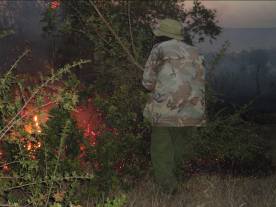
Here below we pay tribute to the officers from Central Highlands Consersancy who recently fought a fire in Ndaragwa Forest Station. The fire had raged for night and day and it was gratifying to see the Head of Conservancy Mr. Waichihi and the Nyandrua Forest Zone Manager, Mr. Kinyili lead their "troops" from the front. The images shown below have been replicated all around the country in the last forty days and in majority of the conservancies.

 An ash-plastered Mr. Waichihi (r)and Mr. Kinyili (l) take a break to refresh after co-ordinating the fire fighting for hours. 
 KFS Rangers in a concerted effort to suppress the grassland fire in Ndaragwa Forest Station 
 Due to the remote and harsh terrain in forests, the tools required to fight fires  include fire beaters, hoes, fork jembes, machetes to clear and bag packs with sprayers. Here we see rangers receiving the equipment on site. 
 Rangers are assisted by members of the community to fight the fire. 

 At nightfall the Rangers and members of community plan how to handle the raging fires. 
 Nightfall 
 Its possible for one or two Rangers to put out a small fire if it is spotted early enough and at its head. However, if its windy and out of sight a small fire can grow into a monster fire that can overwhelm 40 men thereby necessitating a call for help from the Community and rarely to other government agencies like KWS, NYS, Police, etc. 

 Above. Forest Rangers are seen on various dates fighting different fires in Ndaragwa Forest Station.